Melting pot, ethnic stew

Either way, we’re all in this vessel together

渾然一体
kon.zen.i-.ttai

Literally: all – “sort of thing” – one – body

Alternately: Disparate things mixing together to form a harmonious or unified whole. A workable sum of parts. The ideal of American society.

Notes: The 渾 may be replaced with homophone 混, “mix.” The compound may also be followed by ~となる (to naru), “to become (a complete whole).” 渾然一体となる can also simply mean “to be joined together.”

This compound comes to us from the seventh chaper of the Huainanzi (『淮南子』), which we’ve seen before. Note also that things becoming 一体 is a recurring theme in yojijukugo.

KonZenParty

Got to have every class of combat waifu in your strike team, see.

Posted in Japanese, Yojijukugo | Tagged , , , , , , , | Leave a comment

The opposite of charmed

引かれ者の小唄
(Hikaremono no kouta; “The ballad of someone being pulled along”)

Definition:

Putting on a brave face in the face of despair; refusing to admit defeat in a seemingly impossible situation; defiant confidence against overwhelming odds. Like someone condemned for a crime, singing on the way to the execution grounds (while seated on a horse that is being led along).

Breakdown:

We begin with the verb 引く (hiku), “to pull” among other uses, in passive form. This attaches to and modifies the noun 者 (mono), “person.” This noun phrase is connected by the associative particle の (no) to the noun 小唄 (kouta), literally “small song.” The term by extension can also refer to a ditty, a ballad, singing to oneself, or even to humming.

Notes:

A variant replaces 小唄 with 鼻歌 (hanauta), literally “nose-song” but in practical terms, humming.

Example sentence:

「権利を奪われても、命まで脅かされても、引かれ者の小唄のように何気なさそうに公に続けて現れる彼女達は馬鹿なのか、誰よりも勇ましい人達なのか、私には判りません」

(“Kenri wo ubawarete mo, inochi made odokasarete mo, hikaremono no kouta no you ni nanige nasasou ni ooyake ni tsudzukete arawareru kanojo tachi wa baka na no ka, dare yori mo isamashii hito tachi na no ka, watashi ni wa wakarimasen.”)

[“Even with their rights being taken away, even with their very lives being threatened, these women continued appearing in public and acting as if nothing were out of the ordinary, like whistling to the gallows. I really don’t know whether they’re idiots, or braver than anybody and everybody else.”]

Posted in Japanese, Kotowaza | Tagged , , , , , , , | Leave a comment

But what do you do with half a hemp-tangle?

Throw water on it, maybe

快刀乱麻
kai.tou.ran.ma

Literally: pleasant – sword – disorder – hemp

Alternately: Skillfully (and quickly) resolving a complicated situation or solving a complicated problem.

Notes: 快刀 is a sword with a good cutting edge; 乱麻 is a tangle of hemp thread or yarn. The yojijukugo can also be expanded to the phrase 快刀、乱麻を断つ (Kaitou, ranma wo tatsu), where 断つ is “to cut (off).”

This compound comes from a story in the Book of Northern Qi (北斉書, in Japanese Hokusei sho), a Tang-era history by Li Baiyao. It’s said that the father of Gao Yang – later Emperor Wenxuan – gave him a tangled ball of yarn to test his intelligence. Instead of trying to work it out the hard way, Yang took the Gordian-knot solution by cutting the tangle apart with his sword.

Replacing either half of this phrase with any homophone, such as 怪刀 (not a common word; literally “strange sword”) or 乱魔 (similarly, “wild demon”), is considered an error.

See also synonym 一刀両断.

cof

Not the “Ranma” I first thought of; this was the title of a pair of video games, later made into an OVA (Original Video Animation: a direct-to-video animated miniseries).

Posted in Japanese, Yojijukugo | Tagged , , , , , | Leave a comment

And now you understand 90% of every samurai movie

武士は食わねど高楊枝
(Bushi wa kuwanedo takayouji;
“Even a warrior who hasn’t eaten uses a toothpick”)

Definition:

A destitute warrior who hasn’t eaten nonetheless acting like they have, in order to avoid revealing weakness to any potential enemies. By extension, putting on airs or a show of pride, or acting stoic in the face of hardship. Forced cheer.

Breakdown:

We begin with the noun 武士 (various pronunciations, in this case bushi), “warrior,” marked as the topic of discussion by the particle は (wa). The comment on this topic begins with the verb 食う (kuu), “to eat.” This verb appears in imperfective form and takes the negative suffix ず (zu). This suffix itself appears in perfective form as ね (ne), allowing it to take the concessive suffix ど (do), “even (if).” Without particles, this verb phrase is followed by the noun 楊枝 (youji), “skewer” or “toothpick.” Prefixing this noun with adjective-turned-noun 高 (taka), “high,” implies that the toothpick use is leisurely, giving an air of self-assurance or of having just enjoyed a satisfying meal.

MifuneYouji

You get a bonus if you’re Mifune Toshiro.

Notes:

This saying is the ふ entry in the Kyoto iroha karuta set, but is also attributed to the writings of Confucian sage Mencius (孟子, in Japanese Moushi).

Example sentence:

「あいつの精神はな、武士は食わねど高楊枝だから、たとえお前が弁当を分けてあげると言っても一口も食わんだろう」

(“Aitsu no seishin wa na, bushi wa kuwanedo takayouji dakara, tatoe omae ga bentou wo wakete ageru to itte mo hitokuchi mo kuwan darou.”)

[“That guy, he’s got this samurai spirit that doesn’t want to admit any problems, so for example even if you offer him part of your bento, he won’t have a single bite.”]

Posted in Japanese, Kotowaza | Tagged , , , , , , | Leave a comment

None are so lost as those who will not stop being lost

, Darryl

迷者不問
mei.sha.fu.mon

Literally: lost – person – non – ask

Alternately: “The (truly) lost are those who do not ask (the way).” An admonition to ask questions when there’s something you don’t understand. If you get lost – literally or figuratively – and don’t ask the way, you’re just going to go on being lost.

Notes: This phrase comes to us from the writings of Confucian philosopher Xunzi, aka Xun Kuang.

MeiShaFuMonYuki

But until I knock to ask, how will I know where to knock to ask?

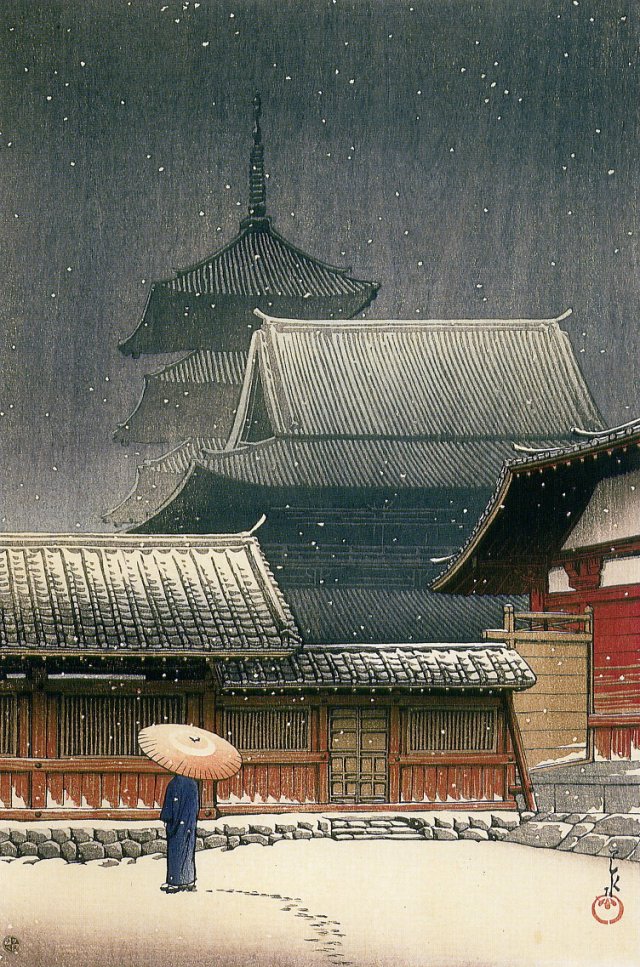
[Image by 川瀬巴水 (Hasui Kawase), Public domain, via Wikimedia Commons]

Posted in Japanese, Yojijukugo | Tagged , , , , | Leave a comment

But does a triple thing happen five times?

1123581321345589?

二度あることは三度ある
(Nido aru koto wa sando aru;
Something that happens twice, happens three times”)

Definition:

Things tend to repeat. If something has happened before, especially more than once, then it should be assumed that it can and will happen again. An admonition to be careful not to repeat mistakes.

Breakdown:

The whole phrase revolves around the noun こと (koto), “(abstract) thing,” as shown by the topic-marker particle は (wa). The noun is modified by verb ある (aru), “to exist,” in prenominal form, and the details of its existence are number-noun 二度 (nido), “two times.” The comment following the topic marker, meanwhile, is number-noun 三度 (sando), “three times,” in turn modifying the verb ある (aru), which appears this time in sentence-final form.

Notes:

This phrase seems to have originated in a jōruri piece called 『驪山比翼塚』 (Meguro hiyokudzuka), a likely-fictional place name.

Example sentence:

「昨日も今日も学校に自転車に乗って行って、事故に遭ったんじゃない?二度あることは三度あるというから、明日はもっと気を付けた方がいいよ」

(“Kinou mo kyou mo gakkou ni jitensha ni notte itte, jiko ni attan ja nai? Nido aru koto wa sando aru to iu kara, ashita wa motto ki wo tsuketa hou ga ii yo.”)

[“You rode your bike to school both yesterday and today and got into accidents, right? If something happens twice it can happen a third time, so you should be more careful tomorrow.”]

Posted in Japanese, Kotowaza | Tagged , , , , , , , | 1 Comment

An osmotic balance of worries?

内憂外患
nai.yuu.gai.kan

Literally: inside – grieve – outside – affliction

Alternately: Troubles both within and from without (a country). Internal and external problems. For example, alienating both your populace and your neighbors. By extension, can refer to the combination of intra- and inter-entity problems for households, corporations, and so on.

Notes: Some versions replace 憂 with 患 and the second 患 with 禍 (ka, “misfortune”).

This compound comes to us from the Commentary of Zuo (『春秋左氏伝』, in Japanese Shunjuu sashiden), which we’ve seen before.

NaiYuuGaiKanAbe

Japanese Prime Minister Abe, pummeled with internal scandals while being excluded from talks between the Koreas, China, and the USA.

Posted in Japanese, Yojijukugo | Tagged , , , , , , , , | Leave a comment

When in doubt, carry a jackhammer

石橋を叩いて渡る
(Ishibashi wo tataite wataru; “Striking a stone bridge and crossing”)

Definition:

Doubling and redoubling one’s precautions. Being extremely careful, especially in terms of safety. Like someone who comes to a sturdy stone bridge and still takes the time to test it by hitting it with a stick before crossing. This saying may be used positively, to encourage thorough vigilance, or negatively, to sarcastically criticize cowardice or unnecessary degrees of caution.

Breakdown:

We begin with compound noun 石橋 (ishibashi), “stone bridge.” The bridge is marked by the particle を (wo) as being the direct object of the verb 叩く (tataku), “to strike” – and also of the following verb 渡る (wataru), “to cross (over).” The first verb is in conjunctive form, so it can link to the second; the second is in sentence-final form, so it can end the sentence.

Notes:

Trivia of the day: Ishibashi is also the family name of the person who founded Bridgestone Tires.

This saying has a number of variations and spin-offs. 石橋 may be expanded from a compound noun to noun phrase 石の橋 (ishi no hashi), “a bridge of stone.” The final verb may appear in imperative form as 渡れ (watare). The need for caution may be emphasized by replacing を with も (mo) or でも (demo), “even.” Taking all possible precautions but not actually following through with action may be expressed by changing the noun structures to 叩いても渡らない (tataitemo wataranai), “doesn’t cross even after striking.” And taking so many precautions that the endeavor ends in failure as a result may be expressed by replacing the final verb with 壊す (kowasu), “to break.”

Example sentence:

普段は適当に食事を作ってほとんど無意識に一人で食べてきた晃が、初めて自分の家に招いた彼女のために石橋を叩いて渡るように、レシピを何度も読んで練習を重ねていた。

(“Fudan wa tekitou ni shokuji wo tsukutte hotondo muishiki ni hitori de tabete kita Akira ga, hajimete jibun no ie ni maneita kanojo no tame ni ishibashi wo tataite wataru you ni, reshipi wo nando mo yonde renshuu wo kasaneteita.”)

[“Akira normally threw together his meals and ate alone, barely paying attention. But now, having invited his girlfriend over for the first time, he was taking every precaution imaginable, reading and practicing the recipe any number of times.”]


Posted in Japanese, Kotowaza | Tagged , , , | 3 Comments

Please do not bend, fold, spindle or mutilate

曲学阿世
kyoku.gaku.a.sei

Literally: bend – study – flatter – society

Alternately: Twisting knowledge or reason in order to fit in with a trend or pander to some powerful element of society. Perverting truth in favor of social or political expediency.

Notes: This all-too-timely phrase comes to us from our friend, the Records of the Grand Historian, in the chapter on 儒林 (Rulin, in Japanese pronounced Jurin).

It’s possible, although less common, to reverse the order of the halves and say 阿世曲学.

Today’s media example isn’t Japanese, but it does have global consequences:

Posted in Japanese, Yojijukugo | Tagged , , , , , , , | Leave a comment

Ah, ha, ha, ha, activity seeds, activity seeds

Whether you’re a mother or whether you’re a brother, activity seeds, activity seeds.

命あっての物種
(Inochi atte no monodane; “Stuff you can do thanks to being alive”)

Definition:

Anything is possible if – and only if – you are actually alive to do it. This saying warns against courses of action that put your life at risk even if overall they seem beneficial and likely to succeed. No potential reward or profit is worth risking your life in trade. When in doubt, err on the side of survival.

Breakdown:

This kotowaza is a noun phrase. It centers on the noun 物種 (monodane), literally “thing-seed” but in usage better translated as “origin” or “foundation.” The associative particle の (no) connects this noun to the verb phrase that modifies it. Said verb phrase begins with the noun 命 (inochi), “life,” followed by the verb ある (aru), “to be,” “to exist.” The grammar is a little unusual: the て conjugation normally marks the conjunctive form of a verb, but here its function seems to be to nominalize the verb phrase so that it can be linked to the following noun with the の.

Notes:

This phrase may be contracted to 命が物種 (inochi ga monodane) or 命こそ物種 (inochi koso monodane), or extended in a playful way by adding 畑あっての芋種 (hatake atte no imodane), “potato seeds thanks to having a field.”

Despite the sound, the final dane is definitely “seed” and should never be read or used as a combination of the copula だ plus tag particle ね.

Contrast the caution of this saying with ones that urge bold action, such as 虎穴に入らずんば虎子を得ず.

This kotowaza comes to us from the works of 19th-century Kabuki playwright Kawatake Mokuami.

Example sentence:

命あっての物種なので、命にかかわる仕事はお断りします」

(Inochi atte no monodane na no de, inochi ni kakawaru shigoto wa okotowari shimasu.”)

[“Since life is necessary for all other things, I respectfully decline a life-threatening job.”]

Posted in Japanese, Kotowaza | Tagged , , , , , , | 1 Comment